Press
Well-Being of Trans People: Seminar Addressed the Contribution Done by Social Sciences
The seminar – which is part of the actions of an InES Gender project (Innovation in Higher Education) – addressed research done by and about trans people, as well as the challenges of a non-sexist education.
October 18, 2023
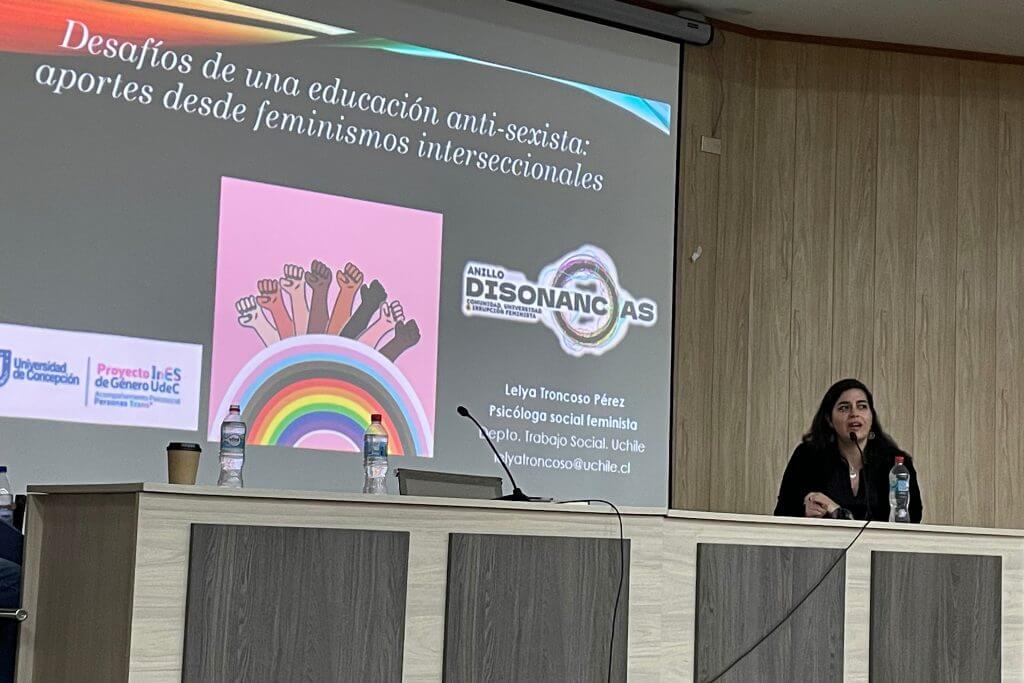
The seminar “Contributions of Social Sciences to the Well-Being of Trans People” was held at the auditorium of the Faculty of Social Sciences of the UdeC, organized by the project “Psychosocial Support for Trans People and their Families in Chile” of the Academic Cecilia Bustos Ibarra. This project is funded by the InES Gender initiative, under the Vice-Rectory of Research and Development.
The seminar was part of a working day of the research team led by Dr. Bustos. It also took place in the context of commemoration of the International Day of Action for Transgender Depathologization (October 22), an event occurred in 2018 when the WHO no longer considered transsexuality as a mental illness, which was the result of activism organized by the campaign “Stop Trans Pathologization”.
Lelya Troncoso Pérez – doctor in psychology from the Universidad de Chile –, Martín Torres Rodríguez – academic at the Pontificia Universidad Católica and deputy director of gender and diversity at the Faculty of Architecture and Urbanism of the Universidad de Chile –, and Ricardo Espinoza Tapia – doctor in social psychology from the Universidad Católica del Norte – gave presentations at the seminar. The topics discussed were the challenges of an anti-sexist education, coping strategies of trans people in the face of violence and participatory methods for trans mapping.
“We want to address the gender and sexual diversity training gap in careers such as Social Work and Psychology. We are in a relevant cultural moment after the feminist May and that puts pressure on universities so that people do not continue to be trained in theses subjects only through diplomas or self-taught way”, said Cecilia Bustos Ibarra – project director.
During the seminar, Maruzzella Valdivia Peralta – deputy director of the Office for Gender Equity and Sexual Diversity – pointed out that these spaces help to reflect on what still needs to be done in this area, considering that “the figures of the T Project of the Universidad Diego Portales show that 91% of trans people have depressive symptomatology and that 42.8% have not finished or have abandoned their higher education. This scenario demonstrates the urgent need to address the inequalities and challenges faced by trans people in our society”.
Laura Palma Rojas – coordinator of the InES Gender project – mentioned that initiatives such as this seminar respond to the VRID InvestigadorAS funding strategy, which not only “incorporates affirmative actions so that there are more women doing research. We also hope that this will bring new topics and approaches to the academy that will benefit the understanding of human diversity in its broadest sense”.
Research and Trans People
The first topic addressed in the seminar was led by Lelya Troncoso, who reviewed the contributions that can be gathered from intersectional feminism for a non-sexist education and to promote critical thinking. “It is important to be aware of the centrality of gender and sexuality in the discourse of the global far-right, especially in times of the rise of far-right speeches and feminist anti-gender movements. Cisnormativity is the central element in the generation of far-right that has an idea of nation, subject and women, among others. We need to start having more critical dialogues”.
Meanwhile, Ricardo Espinoza spoke about his experience of working on violence against trans people and how they experience it. “Violence occurs throughout life in different contexts. Coping happens in different ways: it is expressed in militancy in civil society organizations, also in the consumption of substances and finally in mimicry, or hiding, which is an alternative of adaptation to a society that rejects you”.
The closure was conducted by Martín Torres, who has developed different participatory mapping works, through a methodology that he describes as dissident. “I made a map of connections of trans women in jails, where I went from one person to another, like a snowball. In that work, they reviewed what I was doing, and I developed a way to show numerically what they were telling me. For example, they felt safer in jail than on the streets”. For the UdeC project, Martín is developing a mapping of health facilities with services for trans people. In his presentation, he also reflected on his own story. “Today I was saying that at 40 years old I am old in the trans community and that has to do with a privilege level because I was not expelled from home, I was able to keep studying and when I did not find a job my solution was to study more”.
Therefore, he said “it is political for me to say that I am trans, because generally we are the object of study ant not the ones doing the research”.
By Universidad de Concepción Press